


Emotional ups and downs usually characterize childhood and adolescence, which is due to Disruptive Mood Dysregulation Disorder (DMDD). In some children, irritability and anger go beyond normal moodiness. When intense and ongoing temper tantrums occur, the behavior becomes more concerning. A persistently angry or irritable mood may indicate Disruptive Mood Dysregulation Disorder (DMDD). The situation poses a significant challenge both to children and their families, affecting life back at home, at school and in social interactions. The first step to have the appropriate support and make a child better is to understand DMDD.
The paper will give a broad picture of Disruptive Mood Dysregulation Disorder. We shall discuss its central symptoms, the possible causes, and the effective treatment. We will also demarcate the difference between DMDD and other related disorders, including intermittent explosive disorder, ODD and Bipolar Disorder and briefly how the symptoms of DMDD may surface in adulthood.
What is Disruptive Mood Dysregulation Disorder?
Disruptive Mood Dysregulation Disorder (DMDD) is a mood disorder that affects children, which are incredibly disproportionate in degree or duration to the circumstances. In between these tantrums, DMDD children have an irritable or angry mood that other people, such as parents, teachers and peers, can notice.
The diagnosis was added to the Diagnostic and Statistical Manual of Mental Disorders, Fifth Edition (DSM-5). It improves diagnostic accuracy in pediatric mental health. Even though a few children undergo extreme emotions, DMDD is not similar to normal developmental moodiness.
Frequency and severity of the outbursts and chronic, pervasive irritability between them are the key differentiators. It is not merely a bad day or a stage a child goes through; it is a pattern of poor control over emotions that severely interferes with normal daily functioning.
Symptoms of Disruptive Mood Dysregulation Disorder
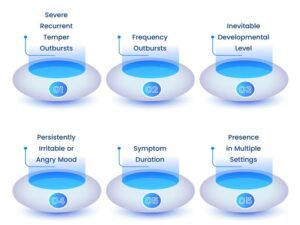
Severe Recurrent Temper Outbursts
They may either be verbal (e.g., rages, screaming) or behavioral (e.g., physically aggressive to people or property). One of the characteristics is that the outbursts are so disproportionate to the trigger. As an illustration, a small demand such as switching off the video game could lead to a devastating tantrum.
Frequency of Outbursts
To qualify a child for DMDD, the temper outbursts should take place, on average, three or more times a week.
Inevitable Developmental Level
The tantrums are not in line with the child’s age of development. A two-year-old may have tantrums frequently, but the same action by a ten-year-old is a serious problem.
Persistently Irritable or Angry Mood
The mood of the child is continuously irritable or angry throughout most of the day, almost daily. This mood is evident to the rest. The child is not, though, grumpy now and then, but rather, he is always negative and can be easily agitated.
Symptom Duration
The patient has had the symptoms for at least 12 months. Later in this period, the child is not able to experience three or more consecutive months without all the symptoms.
Presence in Multiple Settings
The symptoms should be found in two or three settings (e.g., at home, at school, with peers), and in one of these settings, the symptoms should be severe. This is necessary to make sure that the behavior will not merely be a response to the particular environment, such as a stressful home life.
Causes of Disruptive Mood Dysregulation Disorder
Neurological Factors
According to brain imaging researchers, it is possible that children with DMDD do not process information about emotions in a similar way as children without this condition. The scholars have noticed discrepancies in areas of the brain that deal with attention, emotional control, and judging facial expressions. As an example, children with DMDD have a greater risk of interpreting the neutral facial expression as an aggressive or angry one. The amygdala, which is known to control emotion, as well as the prefrontal cortex, which is known to control impulses and make decisions, may be dysfunctional.
Genetic Factors
DMDD can also be hereditary, as are many other conditions of mental disorders. At risk may be children with a family history of mood disorders, anxiety disorders, or substance use disorders. Presumers are also temperamental characteristics that are evident early on in life, like a high level of emotional intensity or an inability to adjust to change.
Environmental Factors
Whereas it is not a direct cause, a stressful environment and adverse life events may worsen DMDD symptoms. The inability of a child to acquire practical emotional regulation skills may be more problematic when there is a lot of family conflict, exposure to trauma, or inconsistent parenting practices. These aspects may combine with the biological predispositions of a child, making one likely to develop the disorder.
Disruptive Mood Dysregulation Disorder Treatment
DDMD treatment is multidimensional, and it depends on the needs of a particular child. The aim is to decrease the irritability, educate the child on the skills of emotional regulation, and enhance the child’s functioning in the home and school. It is usually best applied through a combination of treatment and, in some instances, medication.
Cognitivist behavioral therapy (CBT)
CBT assists children to find out their thoughts and feels that cause them to outburst. They are taught how to question the bad thought processes and acquire more effective coping mechanisms for dealing with anger and frustration.
Parent Training
This is a very, very important aspect of treatment. Therapists also collaborate with parents to educate them on the best methods of reacting to the outbursts of the child. These may involve methods of de-escalating, establishing regular boundaries, and utilizing positive reinforcers to reward desirable behaviors. This is important in allowing a child with DMDD to have a more predictable and stable environment through parent training.
Medication
The given reason is that medication can be examined in case the therapy fails to be compelling enough, particularly when the symptoms are pretty severe and threaten the child or other people.
- Stimulants: Stimulant drugs are sometimes employed since DMDD usually co-exists with ADHD. These would assist in enhancing attention and inhibiting impulsivity, which could further lead to less irritability.
- Atypical Antipsychotics: When a patient is violent and aggressive or has had an outburst that may cause their safety to be threatened, drugs such as risperidone or aripiprazole may be used.
- An effective treatment strategy is one that deals with close cooperation among the parents, teachers, and mental health professionals in order to offer uniformity and coverage at all settings.
Comparing DMDD to Similar Disorders
DMDD has similar symptoms to several other behavioral and mood disorders, and this may lead to confusion during diagnosis. It is essential to know the differences to be adequately treated. A typical comparison is pediatric bipolar disorder. Although the two are similar in the sense that there is irritability and mood instability, DMDD is characterized by non-episodic irritability. This variation in mood pattern is critical in proper diagnosis and long-term treatment planning.
DMDD has a similar confusion with oppositional defiant disorder (ODD) and attention-deficit/hyperactivity disorder (ADHD). ODD has the irritability and defiance that are usually directed at the authority, and DMDD has the same on the mood of the child in various circumstances. Emotional outbursts may also be a part of ADHD, but this is usually associated with impulsivity and not constant anger.
DMDD vs. Intermittent Explosive Disorder (IED)
Both IED and DMDD are associated with explosions of anger. The significant difference, however, is in the mood between episodes of the child.
- DMDD: DMDD children have a consistently irritable or angry demeanor between outbursts of temper. This is chronic irritability, which is a fundamental trait of the disorder.
- IED: The IED persons are not characterized by a constantly angry mood. In between outbursts, they usually have normal moods. The outbursts are isolated, explosive episodes that have an origin and a conclusion.
DMDD vs. Oppositional Defiant Disorder (ODD)
Both ODD and DMDD have to do with anger and irritability. Nonetheless, the type and the intensity of the symptoms vary.
- ODD: The condition is characterized by a continued tendency of defiant, antagonistic, and rebellious attitudes toward authority figures. Though children who have ODD are irritable, the main characteristic is their oppositional behavior, arguing, refusing to obey the rules, and purposely annoying others.
- DMDD: The primary characteristic of DMDD is mood dysregulation. The tantrums are more intense, and they are also accompanied by an irritable mood that is pervasive, which is not a necessary qualification to diagnose ODD.
DMDD vs. Bipolar Disorder
Bipolar Disorder: It is a disorder that is characterized by specific periods of mania or hypomania (elevated mood, energy, and activity) as well as depression. Such mood episodes are of a special duration (e.g., days/weeks long) and are a definite deviation from the normal status that the person has.
DMDD: DMDD is not episodic. The irritability is chronic and persistent as opposed to being separated into periods. Although children with bipolar disorder may be irritable, the salient characteristic is that their mood swings are periodic, which include manic episodes. DMDD lacks manic and hypomanic episodes.
Disruptive Mood Dysregulation Disorder in Adults
DMDD is a childhood diagnosis, and it is impossible to diagnose it in the first place in adults. The symptoms are supposed to be there before the age of 18. The difficulties that come with DMDD, however, do not just disappear when the individual turns 18 years old.
>Longitudinal studies are still running; nevertheless, it has been shown that early childhood candidates of DMDD are more susceptible to developing other mental diseases during their adulthood, predominantly depressive and anxiety disorders.
Adults with DMDD symptoms when they were children might still be unable to regulate their emotions, become irritable, and have problems in their relationships. These adults are frequently treated with such therapies as CBT and DBT that help them to create emotion regulation skills that they could not develop during their childhood.
End Note
Disruptive Mood Dysregulation Disorder is a severe disorder that can be treated. It can be described as intense tantrums and a permanent, negative disposition that has a profound negative influence on the life of a child. It is not merely bad conduct or a transitional stage, but a real battle with the control of emotions.
The most important part is the accurate diagnosis, and it is necessary to differentiate between DMDD and such other disorders as ODD, IED, and bipolar disorder. Given an elaborate treatment program that in most cases involves therapy for the child and training for the parents, children with DMDD can eventually learn how to cope with their emotions.
When you notice the symptoms of these disorders in your child, it is an important step that you get an assessment by a competent mental health expert to achieve a brighter and more stable future. To get more information, consult a useful resource of information such as Mental Behavioral.
FAQs
What is emotional manipulation?
Emotional manipulation is when a person uses guilt, fear, or pressure to control someone’s feelings or actions for their own benefit.
How can emotional manipulation affect mental health?
Emotional manipulation can cause anxiety, low self-esteem, emotional confusion, and constant self-doubt over time.
What are common signs of emotional manipulation?
Common signs include guilt-tripping, gaslighting, the silent treatment, blame-shifting, and making you feel responsible for their emotions.
Can emotional manipulation happen in close relationships?
Yes, emotional manipulation often occurs in romantic relationships, families, friendships, and even workplaces.
Why is emotional manipulation hard to recognize?
It is subtle and gradual. Manipulators often appear caring or concerned, which makes their behavior easy to overlook.
Can emotional manipulation be unintentional?
Yes, some people manipulate emotions without realizing it, often due to unhealthy communication patterns.