


The growing awareness of AuDHD has helped many people finally understand why they struggle with focus, sensory overload, social communication, and emotional regulation at the same time. Although there is a distinction between autism and ADHD as neurodevelopmental disorders, they tend to intersect, which influences daily behavior, relationships, work performance, and psychological well-being. Due to this overlap, a number of people, in particular, adult women, girls, and high-masking adults are not diagnosed with adulthood due to proper audhd.
This tutorial provides a detailed description of what constitutes AuDHD, its symptoms in adults and children, the key signs of audhd, the options of audhd treatment, and the ways of obtaining adequate testing. So, whether you are finding out more about your personality or helping a loved one, this article breaks down the whole process so that you can know and appreciate this unique neurotype in a clear and confident manner.
What Is AuDHD?
AuDHD is a name that is given to persons who meet the criteria of both Autism Spectrum Disorder and ADHD. The conditions are not mutually exclusive as it used to be supposed, but it was proven that a lot of individuals are affected by both of them simultaneously. This comorbid diagnosis affects thinking style, emotional patterns, learning behavior, and daily functioning differently as compared to having either of the two conditions.
Since ASD has an impact on social communication and sensory processing, and ADHD on attention and impulse control, the combination may be confusing and contradictory. As an example, a person can spend hours being hyperfocused and at t, he same time find it difficult to initiate a simple activity. Or they might like organization, and yet they want spontaneity. Learning about this combination allows for enhancing self-acceptance, lessening guilt, and referring people to the appropriate support.
AuDHD in Adults: Why It’s Often Missed
AuDHD is not always detected in adults until, after many years, they realize they are different, misunderstood, or overwhelmed. This is a late realization that is typical since most adults learn to cover those attributes, make up in school, or get used to the workplace strain, not knowing what makes them feel like they work harder. The challenges can manifest themselves throughburnoutr productivity, emotional depletion, or social disorientation.
- They consider their difficulties as personality traits but not as neurodivergence.
- They were raised in a world that did not recognize autism or ADHD in intelligent and high achievers.
- The symptoms manifest in a different way in females, which causes the misdiagnosis or no diagnosis at all.
- The professionals may target anxiety or depression, whereas neurodevelopmental trends are ignored.
AuDHD in Adult Women
Adult women have a low level of ADHD. They tend to be more veiled, emulate societal attitudes and patterns as w,e ll as to coerce and compel themselves into projected social positions. Their symptoms are usually manifested in the form of emotional sensitivity, perfectionism, burnout of the limbs or s, social burnout. Most end up being diagnosed with depression, anxiety or b, or borderline personality disorder, or only to be clarified. Women having AuDHD may experience problems with:
- Overload of sensory in everyday life.
- Dysregulation of emotions in relationships.
- Strain in striking a balance between work demands.
- Even masking successfully causes social exhaustion.
- Not feeling understood or being too much emotionally.
AuDHD in Girls: Early Signs Often Overlooked
Girls have a different manifestation of AuDHD, which results in delayed or incorrect diagnosis. Girls can be either quiet, well-behaved, or academically strong. Nevertheless, they usually have their own problems with sensory challenges, emotional overload, and the need to soto fit in sociallymon. Early signs include:
- Strong interests whichthatsocially acceptable (animals, books, arts).
- Good imagination as a coping mechanism.
- Silent daydreaming is sed with shyness and not with ADHD inattentiveness.
- School masking and home emotional meltdown.
- Hard to read social cues even when he orthey seemndly.
AuDHD vs ADHD: Understanding the Difference
ADHD has its impact on attention, hyperactivity, and impulsivity. AuDHD also incorporates the extra dimension of autistic behavior, including sensory sensitivity, social communicative variation, and inflexible thought patterns. These two groups may have difficulties with executive function, yet motivations, responses, and emotional experiences vary.
- Routines may bring comfort to AuDHDe, but ADHD persons are attracted to novelty.
- Both the autistic communication patterns and the ADHD impulsivity are found to be sources of social problems.
- The emotional breakdowns are usually associated with masking or sensory overload in AuDHD.
- The special overlap can be better understood to assist in treatment and support.
Common AuDHD Signs
The combination of autistic and ADHD traits appears in everyday behavior and emotional patterns. Here are the most common audhd signs:
- Difficulty focusing unless deeply interested
- Switching between hyperactivity and exhaustion
- Trouble starting tasks despite motivation
- Rigid routines but inconsistent follow-through
- Sensitivity to noise, textures, light, or crowds
- Meltdowns or shutdowns triggered by sensory overload
- Need for sensory-seeking behaviors like fidgeting
- Trouble reading body language or social cues
- Over-explaining or struggling to express ideas clearly
- Inconsistent communication patterns (talking too much or too little)
AuDHD Symptoms in Daily Life
The everyday audhd symptoms can impact multiple areas of life. These include:
- Missing deadlines despite knowing the importance
- Feeling overwhelmed in group settings
- Difficulty transitioning between tasks or environments
- Hyperfocus on interests while ignoring basic needs
- Sensory sensitivity affecting clothing choices or food preferences
- Emotional dysregulation impacting relationships
- Sleep disturbances, racing thoughts, or nighttime overstimulation
These symptoms vary from person to person and often intensify during stress, transitions, or burnout.
How to Get an AuDHD Test or Assessment
Accessing an AuDHD test or completing a full audhd assessment is the best way to understand your neurotype and receive a formal diagnosis. Assessments typically include:
- Clinical interviews about your childhood and adult symptoms
- Standardized ADHD and autism screening tools
- Behavioral observations
- Executive-function evaluations
- Sensory and social-communication assessments
- Validation and self-understanding
- Access to workplace or school accommodations
- Clear guidance for treatment options
- A supportive framework for managing symptoms
Medication for AuDHD: What Helps?
Medication for audhd depends on which symptoms impact daily functioning the most. Since it involves both autistic and ADHD traits, treatment often targets:
1. ADHD-Related Symptoms
Medications such as stimulants or non-stimulants may help with:
- Focus
- Task initiation
- Emotional regulation
- Impulse control
2. Autism-Related Challenges
Medication does not treat autism itself, but it may help with:
- Anxiety
- Sensory overwhelm
- Sleep difficulties
- Mood instability
AuDHD Treatment Options
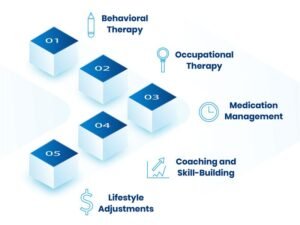
1.Behavioral Therapy
Behavior therapy allows the management of people affected to create and maintain healthy routines and to cope with emotional responses better. It is aimed at enhancing task start, cutting stress, and enhancing communication ability. Individuals are taught real real-lifeics to deal with distractions and be organized. Coping skills on seforory overload and stress are also taught by therapists. This strategy promotes stability in day-to-day lives.
2.Occupational Therapy
Occupational therapy can be used to deal with the sensory sensibilities and enhance the day-to-day functioning of people with AuDHD. It also trains skills of sensory regulation to minimize the feelings of discomfort in overstimulating or noisy situations. Therapists instruct patients on developing a mot skill, coordination, and daily living patterns. They also aide in building the sensory friendly routines to make the transition easier. On the whole, OT can assist in independence and comfort in everyday life.
3.Medication Management
The management of medication is focused on such symptoms as inattention, impulsivity, anxiety, or emotional dysregulation. Psychiatrists also consider the medications that can be used to stabilize the ADHD characteristics in a,ddition to dealing with the problems associated with autism. There are those who are sensitive to stimulants and those who to non stimulants or anxiety controlling drugs. Frequent observation guarantees healthy changes as time passes. Drugs are most effective in conjunction with supportive medications and lifestyle modifications.
4.Coaching and Skill-Building
Coaching offers a systematic leadership to assist individuals to manage their time better, be more productive and organized. The coaches practice breaking down tasks into manageable steps ther,efore reducing the feelings of being overwhelmed. They are also useful in making achievable goals and establishing regularity in day to day lives. Skill-building is concerned with executive functioning, communication methods, and problem-solving. This encouragement will enable people to operate with more confidence in the workplace, at school or e,ven at home.
5.Lifestyle Adjustments
The lifestyle changes provide a normal atmosphere that minimizes burnout and hyperstimulations. Development of routines that can be predicted facilitates transition and enhances emotional stability. People can also include some relaxing activities such as mindfulness, grounding, or sensory pauses. An enabling living or working environment is also lessening. The changes are beneficial in the prevention of mental illness and overall well-being.
Final Thoughts
The initial step in creating a medication plan that benefits an individual through knowledge about the disorder, even though it has been years since the disease was diagnosed. Through proper support, people would know how to cope with sensory overload, become more focused, and establish healthier daily habits without being overwhelmed. An adequate evaluation, a unique treatment plan, and kind instructions form a strategy in the direction of stability and self-acceptance.
Therapy, skill-building, and lifestyle modifications make people with Autism spectrum disorders more confident and adapt to the world. To get a credible perspective and advice, it is always advisable to consult reputable sources like Mental Behavioral, where the information is given in a precise, careful, and well-structured manner that is geared towards the overall well-being.
FAQs
What is AuDHD?
AuDHD is a term that characterizes those people who possess Autism Spectrum Disorder and ADHD. This combination has an impact on attention, sensory processing, social communication, and emotional regulation.
How do I know if I have AuDHD?
You could observe attention difficulties, sensory overstimulation, emotion, and social difficulties. The most appropriate method to determine is a professional audhd assessment.
Is AuDHD more common in women?
Yes. The diagnosed cases of AuDHD in women remain unnoticed since they conceal the symptoms and seem socially competent when in f, fact, they are grappling with the disorder.
What is the distinction between ADHD and AuDHD?
ADHD has an impact on focus and impulsiveness, whereas AuDHD has other autistic characteristics, such as sensory sensitivity and communication differences between socially and communication differences.
What are the treatments for AuforD?
This can be treated with therapy, medication, occupational therapy, and a change in lifestyle, depending on the needs and aspirations of the person.