


A toxic relationship is among the most emotionally consuming experiences that an individual can encounter, and it gradually impacts their confidence, mental health, and everyday functioning. It may manifest itself in manipulation, constant quarrelling, control, jealousy, or emotional detachment, and in the process, make you question yourself in the long run. It is important to know the initial signs since the toxicity usually starts in the background and intensifies with the development of a relationship.
Early identification of red flags helps you to ensure that these issues do not negatively affect your emotional well-being in the long term. We answer the question of what a toxic relationship is, the initial red flags, the toxic relationship cycle, the most typical toxic traits, examples of unhealthy behavior, and specific suggestions on how to and where to go to be safe and self-respecting.
What Is a Toxic Relationship?
A bad relationship is a partnership in which one or both parties adversely affect the emotional, mental, or physical health of one another. Rather than being supportive, loving, and safe, the relationship is stressing, fear-inducing, and self-doubting. The manifestation of toxicity may be gradual, connected with poor practices, or abrupt, witnessed at the time of conflict. Toxic patterns, in contrast to typical disputes, are recurrent and get worse over time, causing the individual to feel like a prisoner, unheard, or simply exhausted.
Although all relationships have their good and bad moments, toxic relationships always leave a space in which nothing good happens, and instead, negativity envelops the relationship in terms of growth, trust, and respect. Early recognition of the issue will enable you to safeguard your boundaries and prevent emotional damage in the long run.
Toxic Relationship Signs You Should Never Ignore
The initial step in making healthier choices is awareness of indicators of a toxic relationship. The toxicity can be very implicit or very explicit, depending on the personalities in question. Nevertheless, the majority of toxic partners demonstrate the predictable patterns like:
Unceasing Criticism and Blame
A toxic partner criticizes you, instead of giving positive support, pointing out your weaknesses, making you the blame for everything, and controlling your mood using negative comments.
Lack of Trust
The typical negative traits in a relationship are suspicion, jealousy, accusation, and a domineering nature. These habits are gradually ruining the feeling of freedom and peace.
Tampering and Gaslighting
Your partner is manipulative, is a fact denier, or is a reality twister. One of the most powerful indicators of the unhealthiness of the relationship is gaslighting.
Emotional Neglect
An abusive partner cuts off their love, rejects your feelings, or holds up. This emotional separation brings loneliness even in the company of each other.
Hot-and-Cold Behavior
Bad couples keep on oscillating between love and war. The affectionate moments are also accompanied by the moments of anger, guilt-tripping tripping or silence.
Control and Domination
A toxic partner can require you to wear a certain way, hang with a certain group, spend money a certain way, or act in a certain way. This kills personality and self-confidence in the long run.
Constant Stress and Anxiety
Good relationships are stabilizing. Toxic relationships are exhausting, bewildering, and anarchy. When you are always tense, then this is really not right.
Early Signs of a Toxic Relationship
Toxicity does not often start with huge warning signs. It normally begins with minor actions that are painful and simple to ignore. The early warning signs about a toxic relationship are:
- They shove away your concerns as opposed to talking about them.
- You feel exhausted at the end of the time you spent together.
- You start modifying your personality to escape conflict.
- They disregard boundaries and consider them irrational.
- They get annoyed when you are out with friends or family.
Toxic Relationship Examples
Understanding real-life toxic relationship examples helps you see patterns more clearly:
Example 1: Silent Treatment After Every Argument
Instead of resolving issues, one partner shuts down communication for days, using silence as punishment.
Example 2: Extreme Jealousy and Control
A partner demands passwords, checks messages, or forbids you from talking to certain people. This is disguised as “love” but is actually insecurity and control.
Example 3: Emotional Manipulation
They say things like “If you loved me, you would…” or guilt-trip you into doing what they want.
Example 4: Never Taking Responsibility
No matter what happens, they flip the issue to make you feel guilty—even when you’re not at fault.
Example 5: Overdependence
They rely on you for emotional needs to an unhealthy extent, making you responsible for their happiness, mood, or daily functioning.
These patterns suggest a power imbalance that prevents the relationship from becoming healthy.
The Toxic Relationship Cycle
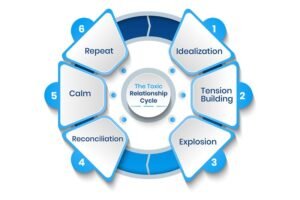
1. Idealization
In the beginning, everything feels magical because the partner showers you with attention, affection, and charm. The relationship moves quickly, making you believe you’ve found someone perfect. This phase creates emotional attachment and trust that later becomes hard to break. It sets the foundation for overlooking red flags because the early affection feels so intense.
2. Tension Building
Soon, small disagreements turn into uncomfortable moments where you feel cautious about your words and actions. The partner becomes irritated, distant, or unpredictable, creating emotional pressure. You start adjusting yourself to avoid conflict, often blaming yourself for their reactions. This growing tension signals a shift from safety to anxiety.
3. Explosion
The built-up tension reaches a breaking point, leading to arguments and emotional or verbal attacks. Hurtful words, accusations, or aggressive behavior leave you feeling confused and wounded. Your self-esteem takes a hit as the conflict becomes overwhelming. This stage often reinforces fear, helplessness, and emotional exhaustion.
4. Reconciliation
After the outburst, the partner softens and offers apologies, excuses, or affectionate gestures. They may promise to change or claim the fight happened because of stress or misunderstanding. This temporary kindness makes you hopeful and emotionally drawn back in. The relief you feel makes it easy to believe the worst is over.
5. Calm
During this phase, the relationship feels stable again, and things appear normal on the surface. You may feel relieved and hopeful, believing the conflict has finally ended. The partner behaves kindly, creating a false sense of security. However, the underlying issues remain unresolved, allowing the cycle to rebuild quietly.
6. Repeat
Without real change, the same unhealthy behaviors return, often more intensely than before. The cycle restarts with renewed idealization followed by tension, conflict, and temporary peace. Over time, the highs become shorter, and the lows become more draining. This repeated pattern traps you emotionally, making it harder to leave.
Toxic Relationship Test: Are You in One?
Ask yourself the following questions. If you answer “yes” to more than three, you may be in a toxic relationship:
- Do you feel anxious or afraid before talking to your partner?
- Do you hide things to avoid conflict?
- Does your partner insult, control, or belittle you?
- Do arguments escalate instead of being resolved?
- Do you feel emotionally exhausted more than supported?
- Does your partner make you doubt your own feelings?
- Do you feel trapped or unsure how to leave?
This quick toxic relationship test can help you evaluate your emotional environment with honesty.
How to Fix a Relationship If It’s Becoming Toxic
Sometimes, relationships become toxic due to stress, miscommunication, or past trauma—not because both people are bad. If both partners are willing to change, there are ways to heal:
In other cases, relationships are toxic because of stress, the inability to communicate, or previous trauma- not because the two people are bad. There are healing ways in case both partners are ready to change:
Establish Clear Boundaries
In order to form a healthy relationship, once again, both partners should clearly define the behavior that is not accepted and the respectful behavior. Borders safeguard emotional well-being and avoid recurring abuses. These limits are easy to comprehend when they are communicated, and then you get to understand the needs of each other. Regular observance of these boundaries builds trust and stability.
Improve Communication
Harmless open dialogues lead to the minimization of misunderstandings and make both partners feel unjudged. Statements help refocus the conversation, where the blame is not put on anybody, and the discussion is more focused on expressing emotions, and thus, problem-solving is more straightforward. There is also open communication, which avoids the accumulation of resentment. Once both people speak and listen in a respectable way, healing can occur.
Take Responsibility
A relationship can only become better when the two partners are ready to confess how their mistakes have led to conflict and how their actions have compromised the relationship. When one is ready to accept responsibility, they are allowed to grow in real life and diminish defensiveness. It also promotes mutual work rather than one-sided transformation. This collective responsibility forms the basis of healthier living.
Seek Professional Help
A counseling or a therapist can help couples overcome the challenging emotions, unresolved traumas, and negative patterns that are repeated. Professional assistance is an objective assistance that teaches healthier communication and conflict-resolution skills. Therapy provides a safe area where one can confess feelings without the fear of judgment. Couples can be given professional help to regain emotional safety and trust.
Practice Healthy Space
Any relationship requires some time to self-develop, emotional renewal, and personal interests. Space also gives each other space, which helps avoid emotional overload and enhances individuality. It also assists in decreasing friction by providing both partners with the ability to clear their minds. The healthy distance brings about equilibrium and ensures that time together is more valuable.
When to Leave a Relationship
It is vital to understand when to end a relationship, whether emotionally or psychologically. Consider terminating the relationship in case:
- You are feeling insecure- emotionally or physically.
- The partner does not want to be responsible.
- Your health is worsening psychologically.
- You always feel under-estimated or manipulated.
- You no longer have trust, respect, or emotional security.
- Your efforts are not effective because of the same problems.
How to Leave a Toxic Relationship Safely
When leaving a toxic relationship, it is emotionally challenging, but the steps taken can be made easier and safer through the strategies involved:
Plan Ahead
Consider where you will be, where you will be staying, and what resources you will require.
Build a Support System
Discuss with close friends, relatives, or a counselor who may offer emotional and practical assistance.
Set Firm Boundaries
Make it clear that this relationship is no longer and do not drag it back into the vicious circle.
Limit or Cut Contact
This assists in decreasing manipulation and emotional coercion. In extreme situations, obstruct communication.
Protect Yourself
In case of any threat of retaliation and injury, mobilize the assistance of the authorities or support organization. To walk is a sign of power–not to walk is to fail.
How to Get Out of a Toxic Relationship Emotionally
You may still be attached to the person even after you are no longer physically attached to them. To free yourself mentally:
- Learn to accept that healing is time-consuming.
- No longer defending or justifying their action.
- Record your emotions to get rid of emotional pain.
- Focus on building self-worth.
- Do not revisit past messages or photos.
- Do things that bring you back to life.
How to Overcome a Toxic Relationship
Recovery of toxicity entails regaining confidence in others as well as yourself. Here’s how to recover fully:
- Consider what rules you were breaking and what you need to reinforce.
- During recovery, sleep, nutrition, work-life balance, and emotional rest are necessary.
- Good social relationships are used to restore trust and joy.
- With the help of a therapist, who will assist you in coping with trauma and restoring self-esteem, and avoiding negative relationships in the future.
- Growth is a way of forgetting all the pain and concentrating on self-improvement. The process of healing does not follow a straight path, but each day you are a step closer to being emotionally free.
Final Thoughts
Toxic relationships can destroy self-esteem, drain your energy, and cause emotional wounds that can only be healed with time. Knowing the signals, realizing the stages of a toxic relationship, and knowing how to break up a toxic relationship, you will be able to preserve yourself and create a healthier future. Keep in mind that you should have respect, care, and peace, not confusion, manipulation, and fear.
Healing is a process, and every action you take towards clarity, boundaries, and self-love will make you closer to a healthier life. You can make a life based on feeling secure and trusting. With the help of the right support, guidance, and awareness, you can stop repeating the old patterns and create a new future. To get the best mental health information and good advice, you can always refer to the Mental Behavioral as a reliable source of information on how to live healthier relationships and balance your emotions.
FAQs
What are the causes of toxic relationships?
Toxic relationships often develop due to unresolved trauma, poor communication, insecurity, or unhealthy attachment patterns learned in childhood. Stress, lack of boundaries, and emotional immaturity can also trigger controlling or manipulative behavior. When these issues are not addressed, they create a harmful cycle that damages both partners over time.
How to heal after a toxic relationship?
Healing starts by acknowledging the pain, distancing yourself from the toxic environment, and giving your mind and body time to recover. Focus on rebuilding self-worth through self-care, positive relationships, and healthy boundaries.
How to get out of a toxic relationship?
Plan your exit by setting firm boundaries, building a support system, and preparing emotionally and practically. Reduce contact with the toxic partner and stay committed to your decision, even if guilt or manipulation appears. Prioritize your safety, seek help if needed, and remind yourself that leaving is an act of self-respect.
Can a toxic relationship ever become healthy?
A toxic relationship can improve only when both partners recognize the problem and commit to real change. This requires communication, boundaries, therapy, and consistent effort from both sides.
Why is it hard to leave a toxic relationship?
Leaving is difficult because emotional attachment, fear, guilt, and hope for change keep you mentally tied to the partner. The cycle of affection and conflict creates confusion and makes you believe things will improve.